Showing posts sorted by relevance for query Green Sun. Sort by date Show all posts

Thursday, May 10, 2018

Some Quick Shots


Too many books, too little time. However, these are among the best that have come my way over the last couple of months:

-Green Sun by Kent Anderson (Mulholland Books). Noir cop adventures unlike any other. Takes up from where Anderson's Night Dogs left off. Which if you  haven't read, you should immediately track down. And if you have read it, you know what you are in store for with Anderson's latest. Vietnam vet Hanson is now perusing the streets of Oakland, wondering, of course, if it's worth it. I imagine that Anderson's books are as close as it gets to telling like it is when it comes to the politics of being a cop.

-South Atlantic Requiem by Edward Wilson (Arcadia Books).  Wilson once again proves himself to be one of the best around at tracking late 20th century UK/US spook connections. His seven novels constitute a virtual history of that period.  His latest, which of course features his favourite MI6 agent William Catesby, concerns the Falklands War. About time that some novelist lifted the lid on that one, with its sordid, Trump-like crimes. And there's no one better suited to the task than Wilson.

Ivory Pearl by Jean-Patrick Manchette (NYRB). Perversely, perhaps, this has long been my favourite Manchette novel, finally available in a superb translation by Donald Nicholson-Smith. Unfortunately, Manchette died before  finishing it. However, his son, Doug Headline, was able to put the finishing touches to it. Manchette believed the polar had hit a deadend, and this was, for him, the future of hardboiled nor.  Which is to say, to open the genre to the ins and outs of global capitalism, and let the bodies fall where they may. Set for the most part in Cuba's Sierra Maestra mountains in the 1950s, around the time of Castro's landing, Ivory Pearl reads like a cross between Ross Thomas and John LeCarré, with, of course,  the political engagement of Manchette, ever the  unreconstructed soixante-huitard, thrown in for good measure.

-Body & Soul by John Harvey (Heinemann). Ex-cop Frank Elder, with whom most  Harvey readers will be familiar, is now on his own, living in Cornwall. His daughter, the victim of a vicious attack in a previous novel, is now scrambling to make a life for herself in London. She lands a job modelling for a highly-rated but personally suspect artist, later found murdered. Not that one has to work hard to suspend one's disbelief, because, as usual, Harvey's characters are believable, his locales evocative, and his humanity crystal clear. Moreover, the portrayal of the thin-skinned but compassionate Elder as he as he negotiates the dark side of the art world and his own demons, is never less than touching.


-The Annotated Big Sleep by Owen Hill, Pamela Jackson and Anthony Rizzuto (Vintage Crime/Black Lizard). A must for any Chandler obsessive.  It also happens to be one of the most entertaining, perhaps funniest, books I've read for a while. Everything you wanted, and maybe didn't want, to know about Chandler, The Big Sleep, and the world around it. Any serious Chandler reader will know some of the information, but what they will probably enjoy best is when the book best ventures off-piste exploring tangentially related bits of information. So pour yourself a gimlet and enjoy The Big Sleep as you never have before.


-I'll Be Gone In the Dark by Michelle McNamara (Faber). Generally, I don't read  much true crime, but McNamara's book is as much about her  obsession with the Golden State Killer who raped and murdered women for more than a decade, as anything else. We now know someone has been arrested for those crimes. One naturally wonders if McNamara's book had anything to do with the suspect's arrest. McNamara, who grew up in the area of Northern California where the crimes took place, fills her book with grisly details, but the most interesting aspect, at least for me, are those parts in which she writes about herself, her background and her obsession with the case. She died before completing her book, but  true crime writer and researcher Paul Haynes teamed up with McNamara's husband Patton Oswalt to add the finishing touches. A fascinating and absorbing investigation, wonderfully written, and, despite its subject, impossible to put down.

Friday, December 21, 2018

Noir Fiction and Non-Fiction, My Favourites from 2018


It was a good year for noir fiction. But these were the books that stood out for me.  I've included links to those that I reviewed. A couple came in a bit late to be reviewed on this site. Maybe I'll get to them at some point in the near future.


-Give Me Your Hand, Megan Abbott

-Green Sun, Kent Anderson

-November RoadLou Berney

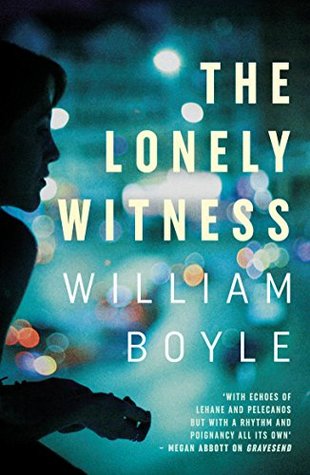
-The Lonely WitnessWilliam Boyle- 

-The Syndicate, Clarence Cooper Jr.-

- Pulp According to David Goodis, Jay Gertzman

-So Many Doors, Oakley Hall 


-The Annotated Big SleepHill, Jackson, Rizzuto- 

-Ivory PearlJean- Patrick Manchette

- I'll Be Gone In the DarkMichelle McNamara-

 -Only to SleepLawrence Osborne- 

-The Long TakeRobin Robertson

-The Prague Coup, Jean-Luc Fromental, Miles Hyman


Friday, February 20, 2015

Edward Dorn's Derelict Air: From Collected Out, edited by Justin Katko and Kyle Waugh

This is one of those books that should come with both a caveat and a health warning. The latter should probably accompany any book by the contrarian poet of the American west Edward Dorn. Maybe something like  reading this book can seriously endanger your relationship with the world as you know it. But it should also come with a caveat that any potential reader, before dipping into Derelict Air, should first crack open Dorn's Collected Poems (Carcanet, 2012). Not that most of the poems in Derelict Air, painstakingly put together by Justin Katko and Kyle Waugh for Enitharmon Press, aren't strong enough to stand on their own. But to fully appreciate these poems one should, at the very least,  have some knowledge of Dorn's published work, from The Newly Fallen and Hands Up to Geography and North Atlantic Turbine, from Gunslinger to Recollections of Gran Apacheria, and from Abhorrences to Westward Haut, and Chemo Sabe.

The title Derelict Air: From Collected Out, comes from an early poem in this collection, but it also carries overtones of Dorn's narrative poem Idaho Out which appeared in his 1965 book Geography. "Collected Out" also suggests that these poems might be out-takes, though Katko and Waugh prefer to call them "poems of becoming." True, Derelict Air, weighing in at over 500 pages, represents a substantial amount, though not all, of Dorn's mostly unpublished poetry. But what's impressive here isn't just the quantity- apparently there was a good deal more that could have been included- but the quality of the work.  The fact is, most of these poems, in some cases only parts of a whole, read like finished products. While Dorn's Collected Poems contained a good whack of uncollected work, Derelict Air has ventured a step further. Of course, a book of mostly unpublished poems can be tricky. After all, how many poets can you think of whose unpublished work merits reading? But, in this case, it definitely makes for an interesting and important book. Particularly for those Dornistas who, over the years, have poured over the contents of The Collected Poems. Equally important, it makes one realise that Dorn was not only constantly writing, but constantly editing his work,  boiling it down to its essentials.

So one is hardly going to feel short-changed by Derelict Air. After all, these poems comprise, or are part of, over twenty different collections, dating from 1953 to 1999, the year of Dorn's death. While even the most dedicated Dorn reader will be unfamiliar with titles like Looking For a Thing (1957-59), Poems of Washington, Idaho and Mexico (1959), Late in the Revolution (1960-62), Silent Guns (1961-63), A Circle of Songs (1964), In the Face of the Liberal (1964-68), A Convention in a Wallpaper Store (1968), The Grave of Diana (1968-70), The Day and Night Report (1970), Office Equipment (1976-83), The Theater of Money (1971), A Mexico Scrapbook (1972), From the Wrong Side of the Partition- At the Houston MLA (1980-81), and The Connection to Nowhere (1992-99). Likewise, that reader may or may not be surprised by the subjects and formats, from a book of illustrated children's poems to political critiques, such as his poems on the Cuban revolution and missile crisis, and a series of short takes "Intended to be strewn on the floor/ of the 1968 Democratic convention."  

Other poems will be more familiar:  Gunslinger Fragments and Satellites (1970-74)- "Nought was on the set/ when zero placed his bet/ on by whom/ the engine would be BLED and with whom/ the secret train departed/ and, exactly when/ the man had/ started his trip"- Translations with Gordon Brotherston (1971-75, some of which appeared in Dorn and Brotherston's The Sun Unwound), Mellow W/ Teeth (1972-76), Homage to Gran Apacheria (1973),  More Abhorrences (1983-89), Abominations (1991), Denver Skyline (1993-99) and Plus De Languedo Variorum: A Defense of Hersey and Heretics (1992-99). Some of these out-takes could have been included in the appropriate collection.  But even though there are some real nuggets here, I'm not sure their inclusion would have necessarily improved the already published product. However, reading them here, they actually add substance to the finished versions, while, at the same time, demonstrating Dorn's ability, despite his range of subject matter and approach, to perceive the superfluous.

Some of the early poems fall short of what one would come to expect from Dorn, but not by much. Here, for instance, is the first stanza of the title poem,  from sometime around 1953: "A sharp green counter/ was where she sat/  & her color was/velvet it darkened/just right, like love." Not all that far off from lyrical poems that would appear eight years later in Dorn's first collection The Newly Fallen. On the other hand, one tends to forget that Dorn didn't really mature as a poet until he was in his thirties. And while he's often lumped in with various Black Mountain poets, he soon moved beyond the confines of that nebulous, if not meaningless, category. Still, there are those who would   portray him as such, citing Gunslinger as the point at which Dorn broke ranks with his former associates. Disregarding the fact that Dorn's poetry was always shifting in accordance with his interests, one could just as well cite other such points, such as Idaho Out, which mutated into the more radical North Atlantic Turbine. Then shifting once again in poems like The Cosmology of Finding Your Place and The World Box-Score Cup of 1966. That inhalation of the culture would crystallise in Gunslinger, which, following the death of (the) "I," would lead to Recollections of Gran Apacheria, gradually bringing the narrator back into the poem with the writing of Abhorrences and beyond.

These shifts are equally apparent in Derelict Air, moving, as it does, from the lyrical to the political and paradoxical.  The final poems in Plus de Languedoc Variorum: A Defense of Heresy and Heretics demonstrate that, though he was always political and, at least since Abhorrences and Hello, La Jolla, always flirting with the subversive, it's around this time that he really cranks up the volume. For instance, in Unabomber as Heretic, Dorn says, "The real and effective criminal here is not Ted Kaczynski but the legions of industrialists and their hierling scientists who for the past quarter millennium have hewed to the principle that if it can be found out if must be found out- the serpents in the Garden of Eden climbing the tree." While in A Review of Volume 10 of the Olson/Creeley Correspondence, Dorn contemplates suing the Olson estate, with Creeley as co-conspirator: for "the failure to hold up the text of James Thomson's/ City of Dreadful Night was deep intellectual abuse, intentional/ and deceitful- there's no forgiving such selective omission." And in Jesus- He was a Handsome Man, An Essay On the Reconstruction of the Whole Western Myth, Dorn, committing the ultimate Black Mountain heresy, writes, "One of the most powerful crossroads in modern poetry occurs in the West, when ee cummings meets Buffalo Bill, when cummings writes Bill's obit. Buffalo Bill's/defunct is the quintessential 'modern poem, not The Wasteland or The Cantos." After Subtexts, which extends the contrarianisms of Abhorrences while demonstrating that old Gunslinger adage that "only laughter can blow it to rags," one arrives at NAZDAKS, parts of which underscored the version found in The Collected Poems. But it appears here in unadulterated form,  all caps, consisting of warped news flashes, absurd updates and state of the  nation stock exchanges: "TELEFONUS INTERRUPTUS--BREAKFASTUS INTERRUPTUS--MENU MENISCUS--LUNCHCHECK UPCHUCK--DUMP IT--EERIE THEORY UP AN EIGHTH--DREARY THEORY UP A QUARTER--LEERY THEORY UP A HALF--QUERRI THEORY UP ONE AND A QUARTER--DUMP IT QUICK--SPEED OF THOUGHT DOWN A FIFTH...".

Reading Derelict Air, I kept wondering whether Dorn had read many of these poems in public. This, in turn, made me think about Dorn's relationship with publishers. One would have thought that at least some of the collections in Derelict Air would have been published during Dorn's lifetime?  Was it that Dorn held them back, or was it that no one wanted to publish them? Katko and Waugh, writing in the preface, quote a 1963 letter from Dorn to Jeremy Prynne: "I have been screwed of publication in america for verse." But that was quite early on, a year before Hands Up, published by Totem Press, and two years before Geography, published by Stuart Montgomery at Fulcrum.  Katko and Waugh go on to say that most of the early manuscripts and lost books made the rounds of publishers, and were presumably rejected, after which they were turned into other poems, lost or left behind. While this illustrates the task Katko and Waugh, with the help of Dorn's family and friends, had in putting this volume together, it also hints at Dorn's relationship with publishers. Some like Totem, Black Sparrow, Fulcrum, Grey Fox,  Frontier, Wingbow, Turtle Island, Etruscan, and, after Dorn's death, Carcanet, Shearsman and, now, Enitharmon, were more than willing to publish his work. At the same time, he's noticeably absent from the likes of  City Lights and Grove Press, not to mention larger publishers who occasionally dabbled in poetry. Whether Dorn had any desire to publish with such companies is another matter. Though, given his disposition, it's difficult to imagine Dorn publishing with some corporate subsidiary. And what about the unpublished collections from the 1960s onwards? But as Dorn was wont to say,  if a person says what they think and does so in a straight-forward manner, they aren't going to get a lot of grants, nor, one supposes,  are they likely to find many publishers.

Impossible to classify, Dorn wasn't  just a poet of the west, but, to quote the title of his 1993 book, a poet of the way more west. While that might sound like the name of an outlaw country singer, it indicates, as do the poems in Derelict Air, that Dorn's west stretches all the way to the horizon. Beyond boundaries, to a kind of Manifest Destiny in reverse, first glimpsed in North Atlantic Turbine. And he would remain committed to that pursuit, whether in quick lyrical shots, narrative journeys, critiques of history, short sharp shocks, screeds of metaphysical humour and paradox, or incendiary tracts and rants. In any case, it's all here in Derelict Air, proving that Dorn, whether published or unpublished, was a force to be reckoned with. Someone who, as Amiri Baraka once said, "wd rather/ Make you his enemy/ Than lie." Though Neophytes, heed the caveat: tackle The Collected Poems first. You won't regret it.

Wednesday, May 09, 2007

Tabloid Noir: Samuel Fuller's Films and Fiction

Part 2

Fuller’s most forthright portrayals of this “organised lunacy” would be Steel Helmet and The Big Red One. Both are eloquent statements regarding the realities of war. The first was Fuller’s answer to Lewis Milestone’s A Walk in the Sun, which he considered little more than one long cliché. Milestone (All Quiet on the Western Front, The Front Page, The Strange Love of Martha Ivers) must have particularly irritated Fuller, for this would be the second rewrite of the renown director’s work. Not only had Milestone put his stamp on prohibition gangsterism, but, worse, he had, according to Fuller, revised World War Two, glorifying and romanticising war beyond proportion. It would take Fuller more than twenty years to write and realise The Big Red One, but his perseverance would result in his most thorough investigation of the war, focusing, as it does, on the average soldier. In the novel, Fuller even resorted to a literary trick which would articulate his relationship to verisimilitude and the war novel in general. For, at the end of The Big Red One, Fuller says the following:
“A war novel’s objective, no matter how emotional, is to make the
reader feel war. But war means casualties. To take the reader into
reality, one page in the book should be booby-trapped. Since it is
against the law to kill a reader, because it makes unsound business
sense to be wounded-while-reading, it became much safer when
turning back to the combat clock to live backwards than to die
backwards.”

Thus Fuller pulls the rug from beneath the Hollywood-oriented illusion-machine. Realising the actual wartime sites no longer had “the feel” of reality, he substitutes Israel for North Africa, Sicily, France, Belgium, Germany and Czechoslovakia. Not only that, but he chose a rather subversive form of role reversal, having Jews should play Nazi soldiers. Regarding the latter, Fuller said the following:
“Israeli soldiers and civilians wore German helmets over
yamulkas...The concentration camp in Falkenau...was filmed
in the heart of Jerusalem...Jewish concentration camp
survivors played the People’s Army fighting for Hitler,
grimly holding up his picture with their their tattoo
numbers covered...To make a real war movie would be
to occasionally fire at the audience from behind the screen
during a battle scene... But word-of-mouth from casualties
wouldn’t help the film sell tickets. And again, such reaching
for reality is against the law...Anyone seeing the movie or
reading the book will survive.”

This is the same film Fuller had the chance to make in 1949 with John Wayne. But the director turned down the offer, because, in his opinion, Wayne was “a symbol of a kind of man I never saw in war. He would have given it a heroic touch that I hate in war movies. In real combat situations, everyone is scared, everyone is a nervous animal. You can’t determine the heroes from the cowards in advance.”

Though he made some great war films, it’s film noir with which Fuller is most often associated: House of Bamboo, Crimson Kimono, The Naked Kiss, Shock Corridor, Pick-up on South Street, Underworld USA, White Dog, Dead Pigeon on Beethoven Strasse and Street of No Return. A subtle remake of William Keighley’s 1948 Street With No Name, House of Bamboo was directed by Fuller, who would also receive a credit for additional dialogue, in 1955 for Twentieth Century-Fox. Set in post-war Japan, Sandy Dawson heads a criminal ring of former GI’s living in Tokyo. The army sends Kenner to infiltrate the gang. Here Fuller depicts the American occupation of Japan as nothing short of criminal. This is obviously not your usual post-war film. Cultural differences are highlighted to great, and often, surreal effect, as in his images of falling cherry blossoms, the Kabuki troupe and the giant Buddha. For someone described by misguided critics as intolerant, if not rightwing, Fuller delivers a sympathetic portrayal of both interracial romance and homosexuality. It’s another typical Fuller character study. Said Fuller, “I loathe this cliche vision of the underworld... Dark alleys and wet streets... It’s easy to set a pictorial mood, to fill an alley up with shadows and ashcans and black cats. I prefer to find or focus in on something sinister at the edge of a beautiful playground or by children playing around pagodas, to use contrast.”

Crimson Kimono (1959), directed, produced and written by Fuller for Globe Enterprises once again presents a world of extremes. In what might be his most optimistic film, Fuller offsets sensitivity and gentleness with vulgarity and violence. Like House of Bamboo, Crimson Kimono concerns interracial marriage, with the heroine opting for a Japanese-American over a Caucasian. In accordance with Fuller’s vehement belief in racial tolerance, Crimson Kimono portrays both the Japanese-American and the Caucasian as equally sympathetic- “I hate those pat, anti-racist movies of the Fifties with those long-suffering Joes who let a pal have the girl without a fight.” Never one to shun the streets, particularly when budget demands it, Fuller, in this film, again uses location shots to great effect, making Little Tokyo and metropolitan Los Angeles an integral part of the movie.

Also written, produced and directed by Fuller, The Naked Kiss concerns what, at the time, were taboo subjects: prostitution, sexual perversion and physical disabilities. Made in 1964 for Leon Fromkess-Sam Firks Productions, this is arguably Fuller’s most infamous film. Like Shock Corridor, it was photographed by Stanley Cortez, who could count amongst his credits Orson Welles’ The Magnificent Ambersons and Charles Laughton’s Night of the Hunter. With its unforgettable opening and bizarre imagery, The Naked Kiss depicts a world as ordinary as it is bizarre, while walking a thin line between social realism and surrealism. But it’s also an examination of class in America. Said Fuller, “What I wanted was the whole concept of a caste system- not the formal one like they have in India or Japan- but a real sense among the social outcasts that there is something so vile, so low, that even they must scorn it.” However corrupt the characters, Fuller refrains from passing judgment on them, suggesting that the ensuing anarchy constitutes an understandable and even healthy response to society’s strictures and puritanism.

This is also the case in Pickup in South Street (1953, Jules Schermer Productions), another film written and directed, by Fuller. Here, rather than Stanley Cortez, it’s Joe MacDonald (The Street With No Name, Viva Zapata, My Darling Clementine, Call Northfield 777, Warlock, Walk On the Wildside) who is behind the camera, and responsible for some exquisite high-contrast black-and-white photography. Filmed in twenty days, it portrays crime simply as a business. Said Fuller to Profirio and Ursini, “They aren’t criminals out of choice, because they always wanted to be, they do it because it’s the only way they can make a living.” Anti-communist it might be- Fuller, after all, distrusted all governments, be they communist, fascist or quasi-democratic- but it turns any notion of anti-communism on its head. After all, the sympathetic Americans portrayed in the movie are hardly respectable members of society, but are lumpen criminals: in turn, a pickpocket, a prostitute and an informer. As Martin Scorsese points out, America’s fate, in Pickup on South Street, “is in the hands of...outcasts.” When a federal agent asks the pickpocket, “Do you know what Communism is?”, the latter says, “Who cares?” Receiving no glory for their efforts, these demi-mondistes, once their mission has been accomplished, will undoubtedly return to the gutter from which they came.

In the original script, Skip, played by Richard Widmark, says to the FBI agent, “Don’t Wave the goddamn flag at me.” At Romanoff’s in Hollywood during the heat of the Cold War, J. Edgar Hoover, dining with his friend and head of Twentieth Century Fox, Daryl Zanuck, and Fuller, said he objected to the line. Zanuck turned to Fuller and said, “He’s right, we’ll leave out goddamn.” Hoover told Zanuck he knew quite well that was not what he meant. To his credit, Zanuck said, “This is his character talking and that character doesn’t give a goddamn about the flag... Any flag!... Otherwise we’re making a propaganda film and we don’t make those kinds of propaganda films.” For Zanuck was not adverse to backing writers he admired.

Underworld USA (1961, Globe Enterprises) is another film directed, produced and written by Fuller. Derived from a series of articles in Saturday Evening Post by Joseph F. Dinneen, this is a domestic war film that pits the FBI against a crime syndicate. It’s also a brutal, if not sadistic, affair, in which the protagonist, Tolly (Cliff Robertson) associates sex with gathering information. Typical of Fuller, Tolly, who simply wants revenge, stands in opposition to legal, as well as criminal, forces. In the end, violence exhausts Tolly as it does anyone touched by it. Prefiguring movies like Point Blank and The Killers, organised crime is again portrayed as an extension of America’s business ethic and at the root of corporate capitalism.

Made for West German television in 1972, Dead Pigeon on Beethoven Street acknowledges the influence of French director Jean-Luc Godard on Fuller, just as Godard had acknowledged Fuller’s influence in Pierrot Le Fou. It’s one of Fuller’s more bizarre films, a complex thriller about an American agent who visits Bonn to find the person who has killed his partner only to get involved in blackmail, drugs, pornography and murder. Its humour and playfulness makes it a close cousin to French New Wave cinema. Most memorable is the climax in which the protagonist throws, quite literally, everything but the kitchen sink at his adversary. His manic behaviour and willingness to use every weapon at his disposal represent a typically American response, not altogether different from the way America was, at the time, deploying its weaponry in the jungles of Vietnam. Also noteworthy is that the femme fatale is played by Fuller’s wife, Christa Lang, who could count amongst her film credits roles in Godard’s Alphaville, Nickelodeon, What’s Up Doc?, White Dog and Street of No Return. She was also a writer, working with her husband on scripts for Kleptomania (1995), Women in Prison (1994, TV) and Day of Reckoning (1990, TV). Not only does Fuller dedicate the novel, Dead Pigeon on Beethoven Street, to her, but he calls the book’s heroine by her name as well. Unfortunately, wooden performances prevent Dead Pigeon on Beethoven Street from realising its potential. In the end, it remains an uneven and odd film. But no more odd than the book, which, though highly visual- a quality that typifies Fuller’s fiction- reads as though it’s partly a film treatment and partly a hardboiled novel written by a cunning surrealist.

One of Fuller’s more mainstream productions, White Dog (1982, Paramount/Edgar J. Scherick), based on a Romain Gary novel, concerns an actress who unknowingly acquires a dog that has been trained to attack blacks. Here Fuller shares scriptwriting credits with the future director and writer of L.A. Confidential, Curtis Hanson. If films from The Bedroom Window (1987) to L.A. Confidential, are anything to go by, Hanson must have learned something from working with Fuller, particularly when it comes to pace and emotional impact. However, due to the film’s subject matter, Paramount, worried that the movie might spark-off race riots amongst cinema audiences in the South and Midwest, decided against releasing White Dog in the U.S.. Yet Fuller was already accustomed to such censorship. His Steel Helmet and Crimson Kimono had both been banned in the South. Regarding the former film, the U.S. Army had refused the director’s request for combat footage, their reason being that the script included the shooting of an unarmed North Korean. A few years after Steel Helmet, Great Britain would ban Shock Corridor.

Except for some TV work in France, Street of No Return (1989) would be Fuller’s swan song. Adapted from David Goodis’ novel, Fuller directed the film but teamed up with Jacques Bral on the screenplay. It was Bral, working for a French and Portuguese production company, who was in charge of the film. With Francois Guerif- noir expert and head of French publishing house Rivage- acting as artistic director, Street of No Return tries to recapture the spirit of David Goodis. It’s an uneven film and opinion is divided on how successful it is as a film. While some dislike the movie intensely others, including this writer, believe it ranks as one of the better Goodis adaptations.

Fuller had known Goodis when the latter was employed in Hollywood, and, for a time, the two occupied adjoining offices at Warners. They first met when Goodis walked into Fuller’s office and handed him an autographed copy of Dark Passage. He was also carrying with him a copy of Fuller’s The Dark Page. Goodis was the first writer Fuller had come across who had actually paid for a copy of his book. Apparently, Goodis had been attracted by Fuller’s title, thinking it a coincidence that it was similar to the title of his own 1946 novel, Dark Passage. Though other than dark- an adjective that could be used to describe the atmosphere of both novels- Dark Passage and The Dark Page have little in common.

Not long afterwards, Goodis brought Fuller a story he’d come across in the New York Evening Journal about a race riot in Harlem. The byline carried Fuller’s name. What intrigued Goodis was a particular quote regarding what had triggered the riot. Goodis wanted more information, but Fuller was unable to track the quote down. Nevertheless, Fuller’s article would become the basis for Goodis’ 1954 novel, The Street of No Return, which, in turn, would be filmed by Fuller thirty-five years later. Fuller admitted that he wrote the script with Goodis in mind: “Every word, every emotion, act of violence, touch was put in as if Goodis was sitting next to me when writing, or sitting next to me when shooting.” Not surprisingly, Fuller’s Street of No Return was dedicated to the author of the novel.

Three non-noir films were released in 1957, two of which, Forty Guns and Run of the Arrow, have since become classic westerns. The former can be compared to off-beat psycho-sexual westerns like Duel in the Sun and Johnny Guitar. It stars Barbara Stanwyck in the role of Jessica, a gutsy woman who owns the town and her hired forty guns. Stanwyck’s role was originally meant for Marilyn Monroe. Inviting as that might sound, it’s hard to imagine the film without Stanwyck presence. At her perverse best, she is able to make the movie hum with sexual frenzy, a quality that Monroe, despite her obvious talent and allure, might not have been able to carry off so effectively. At the other end of the cinematic spectrum, Run of the Arrow concerns an often-used Fuller theme, that of the individual versus society. A film of ideas, and a treatise on national allegiance, Rod Steiger plays a defeated Southerner, who fires the last shot of the Civil War, heads into Indian country, and, rather than return to the fold of the Union, joins a tribe of Sioux Indians, only to find that, for better or worse, he cannot help but be an American.

The third film released in 1957 was China Gate (Globe Enterprises, Twentieth Century-Fox). Starring Gene Barry, Nat King Cole and Angie Dickinson, it is an adventure story set in Vietnam in the days when it was under French colonial rule. It was also the first American film to mention North Vietnamese leader Ho Chi Minh. Producer Daryl Zanuck- always appreciative of a good story and a man whom Fuller respected- purportedly asked the director who this guy Ho Chi Minh was. Ever ready with a hook, Fuller said, “He was the assistant pastry cook at a London hotel who wound up the head of a nation.” To which Zanuck, a one-time scriptwriter who penned the over-the-top ending for Ford’s Grapes of Wrath- responded, “You hear that? That’s the kind of guy I like! A pastry cook! Goddamn it!”

Wrongly accused by Peter Biskind (Seeing is Believing) and leftwing Cineaste critic Calvin Green of being rightwing, if not fascist (Green: “Fuller is a chauvinist whose jingoistic fervor goes beyond the irrational, amounting to a morbid hysteria.”), Fuller was, throughout his life, an outspoken libertarian, his perspective derived from seeing the world at ground level, whether through war or tabloid investigations into crime and corruption. Not only was Fuller a fervent supporter of individual rights but he was an vocal opponent of McCarthyism. In an essay which accompanies the Fowler-influenced New York in the 1930s, Fuller goes so far as to speak up for the benefits derived from the Norris-La Guardia act, which Fuller points out helped establish strong unions and gave strikers protection from being taken to court by their employers. In that article he also extols the gains which have resulted from anti-monopoly legislation; the Wagner Act, which gave unions the right to collectively bargain; the New Deal; the Writers’, Directors and Screen Actors’ Guilds; sit-down strikes; and the Communist Party’s involvement in creating a Popular Front against fascism. Though Fuller does add that the Party did so after supporting the Hitler-Stalin pact. These are obviously not the opinions of your average rightwing fascist. Surprisingly, Fuller had mixed feelings about 1930s cultural deity H.L. Mencken. According to Fuller, the great journalist’s wit and brilliance often obscured his anti-semitism and anti-New Dealism. Though Fuller tries to temper his critique by reminding readers that the 1930s was an “era of terrible honesty.”

As well as Goodis, Fuller also knew Jim Thompson- he met Thompson a few days after the latter arrived in Hollywood- and seemingly every other writer who passed through Hollywood between 1945 and the 1960s. Though familiar with an array of noirists, Fuller, in his writing and films, rarely resorted to hardboiled clichés, for he was more interested in presenting strong images and reflecting the world as he had seen it. A true original, Fuller, to find work as a director after the White Dog debacle, would leave Hollywood and settle for a considerable period of time in Paris, where he believed his reputation was more firmly established and financial backing was easier to obtain.

Fuller died in Hollywood on October 31, 1997. The Director’s Guild of America announced a Farewell Tribute on November 22nd- thirty-four years from the day JFK was assassinated. Connecting various literary and cinematic traditions- from the journalism of Gene Fowler to the pulp fiction of Goodis, from the poetry of Maxwell Bodenheim to the films of Quentin Tarantino- Fuller would have shrugged off any such irony and romanticism. But the announcement gave an indication of the range of Fuller’s influence and the democratic nature of his work: “Among those scheduled to speak are Peter Bogdanovich, Jonathan Demme, Angie Dickinson, Curtis Hanson, Walter Hill, Paul Mazursky, and Tim Robbins. The program will begin at 9:00 AM and is open to the public.”

Novels Burn, Baby, Burn!, Phoenix, New York, 1935; Test Tube Baby, William Godwin, New York, 1936; Make Up and Kiss, William Godwin, New York, 1938; The Dark Page, Duell, Sloan & Pearce, New York, 1944; The Naked Kiss, Belmont, New York, 1964; Crown of India, Award, New York, 1966; 144 Piccadilly, Baron, New York, New English Library, London, 1972; Dead Pigeon on Beethoven Street, Pyramid, New York, 1974; The Big Red One, Bantam, New York, 1980; La Grand Melee, Christian Bourgois, Paris, 1984, as Quint’s World, Worldwide, Don Mills, Ontario, 1988; Pecos Bill and the Soho Kid, Bayard, 1986.

Friday, September 17, 2010

Geeks, Freaks & Rubes

It seems that William Lindsay Gresham is finally getting the recognition he deserves. What follows is my essay, Geeks, Freaks & Rubes, which accompanied the British DVD of the film Nightmare Alley adapted from Gresham's novel.


Edmund Goulding’s Nightmare Alley hit U.S. screens on October 9th, 1947, just two months after shooting had finished. Made at Twentieth Century–Fox, the project was spearheaded by the film’s star and national heart-throb, Tyrone Power, who, after returning from the war, purchased the rights to William Lindsay Gresham’s best-selling 1946 dime-store novel for $60,000, a sumptuous sum at the time. Coming from a family of actors, Power hoped the film would alter his image, turning him from the smooth romantic lead of pre-war films like The Mark of Zorro and Marie Antoinette into a post-war actor of substance. This at a time when an array of otherwise wholesome American stars were suddenly intent on exploring the dark side of life. For 1947 also saw Lawrence Tierney, already a Hollywood bad boy, in Born to Kill, Gregory Peck in Duel in the Sun, and Robert Mitchum in Out of the Past.

Despite the expense entailed in Twentieth Century constructing some ninety sets and renting the Patterson-Yankee carnival, reassembling it over ten acres of studio backlot, production chief Darryl Zanuck, whose only previous venture into film noir was Humberstone’s 1942 I Wake Up Screaming, never showed much interest in the project. Likewise, it would be the only film noir made by Nightmare Alley’s producer, Georgie Jessel, better known as a popular comedian-toastmaster. Jessel was interested in adapting Gresham’s novel despite never having read the book. It was on the basis of a newspaper review that Jessel suggested the book to Zanuck. At least Zanuck got through the novel, though when he did, he pronounced it unfilmable, telling Jessel it contained too much censorable material. Jessel said he was less interested in the censorable material than the plot, which he crudely characterised as a story about “a carnival barker who found he could hypnotize a few hicks, decided to become a fake spiritualist, mocked the Deity, and got punished for his impudence.” It was only because Power and Jessel were pushing so hard for the project that Zanuck reluctantly gave it the green light.

With such backing, the movie was able to attract some major Hollywood players. It was Power who urged Zanuck to hire Goulding, with whom Power had worked the previous year on the slushily mystic Razor’s Edge. A Hollywood veteran whose career stretched back to the silent era, Goulding was known for films like Grand Hotel, Dawn Patrol, Dark Victory, Of Human Bondage and a silent version of Anna Karenina starring Greta Garbo, but he’d never directed anything so grim or aesthetically interesting as Nightmare Alley. Also hired were cinematographer Lee Garmes (Shanghai Express, Zoo in Budapest, Duel in the Sun, Morocco, Scarface, Gone With the Wind) and the formidable scriptwriter Jules Furthman (Underworld, Morocco, Shanghai Express, To Have and Have Not, The Big Sleep). Able to handle complex material, Furthman’s brief was to put together a screenplay that would appease the Production Code office while, at the same time, do justice to the novel, not an easy task when one considers the book’s language, its explicitness and its backstories, including the neglect, if not abuse, suffered by Molly as a child, and the death of Grindle’s young sweetheart after a backstreet abortion.

Other than Power as the ambitious Stanton, and former Ziegfeld girl and studio workhorse Joan Blondell (Cry Havoc) as the maternal Zeena, most of the actors were hardly household names. Yet Coleen Gray (Kiss of Death), Helen Walker (Murder He Says) and old-timers like Julia Dean (Curse of the Cat People), Taylor Holmes (Gentlemen Prefer Blondes) and former Shakespearean actor, Ian Keith, are uniformly excellent. While it wasn’t unusual for an A-movie to masquerade as a B-film noir – one could point to The Big Sleep, Double Indemnity or Out of the Past – Goulding’s movie is darker than most such films. Dark not only in its view of the world, but dark, thanks to Garmes’s use of primary source lighting, in appearance, with many shots truncated by shadows and only a handful of scenes taking place in daylight.

Goulding (1891-1959) is not exactly the first director who comes to mind when thinking about film noir. Like Jessel, this would be his only venture into the genre. And like Zanuck, Goulding initially thought the book unfilmable, yet he too was entranced by its subject matter. What’s remarkable is that Goulding, a jack-of-all-trades director, whom the Los Angeles Times described as “a husky, genial extrovert who sports screaming color combinations and cracks wise in stentorian tones touched with British,” could make such a downbeat movie. Few, Power included, expected Goulding to go to such extremes. On the other hand, there was a dark side to Goulding, which included a fondness for drugs, alcohol, bisexual orgies – directed with the same care he gave to his films – voyeurism, casting-couch liaisons and gay one-night stands. Screenwriter Frederica Sagor would even say that, despite being a Christian Scientist and reading his Bible each morning, the director was nothing short of a deviant. Certainly, Nightmare Alley conveys a particular side of the director’s personality, and is doubtlessly the most personal of all his films.

Born in London, Goulding had been known as an actor’s director, having obtained career-establishing performances from Garbo, Joan Crawford, Joan Fontaine, Mary Astor and Bette Davis. It’s difficult to know if the aesthetic success of Nightmare Alley can be attributed to Goulding’s hitherto- unrealised ability to negotiate the tricky waters of film noir, or if the result had more to do with the chemistry resulting from various professionals working together on the project. Whichever, Goulding appears conversant with the genre’s vocabulary, enough to make Nightmare Alley’s apparent quirks seem premeditated or the result of Production Code compromises. Even before its release, letters of protest were arriving at the studio regarding the film’s view of religion. This prompted Code Executive Joseph Breen to dash off a series of memos to Fox, reminding the studio that breasts must be covered at all times; that there must not be any open-mouthed or lustful kissing; and that there shouldn’t be any suggestion that Stan and Molly have premarital sex, “since it would be a story of illicit sex without proper compensating moral values.” This accounts for the film’s out-of-kilter quality and gaps, which, for the most part, have to do with Stanton’s liaisons. However, Stanton’s affairs of the skin cannot account for the second and third act moving at a swifter pace than the film’s leisurely first act. Could this be because Goulding envisioned a longer and more ambitious movie, and had to cut it down to size within a relatively short post-production period? Nevertheless, in a genre in which plot is rarely paramount, such shortcomings only serve to give the film an even more noirish quality.

One wonders if Goulding and Garmes, working in the technological, if not aesthetic, shadow of Citizen Kane, might have been playing with various noir trademarks, not unlike Welles in Lady From Shanghai. Yet, according to the cinematographer, Goulding “had no idea of camera; he concentrated on the actors. He had the camera follow the actors all the time.” Still, Goulding’s staging did lead to the composition of certain shots. As Garmes said, “[Goulding] was the only director I’ve known whose actors never came in and out of a sideline of a frame. They either came in a door or down a flight of stairs or from behind a piece of furniture.” Whatever Goulding’s input, Garmes must be credited for the look of the film, particularly when it comes to his stunning and brilliantly eccentric lighting. Not just his deployment of shadows but the dark delineation of space, cramming carnival life into walkways, tents, platforms and trailers, while characters reveal themselves and their proximity to each other in a series of intimate close-ups.

What makes Nightmare Alley different from other films in the genre is not merely its bleak perspective, but its cinematic and narrative symmetry. But then this is a film adapted from what is probably the only pulp novel to be influenced by T.S. Eliot and the tarot deck. Consequently, shots and lines are repeated throughout the movie. One notes this in scenes in which the camera focuses on the back of Stan’s head, as though to convey his opacity and his vulnerability. Then there’s Pete’s speech, in which his beloved bottle becomes a crystal ball, reiterated by Stan in the film’s finale. Or Stan saying to Zeena, regarding the carnival geek, “I can’t understand how a man can get that low,” not knowing the same will be said of him. This concern with symmetry is also apparent when Zeena reads the cards, the meaning of which the hubristic but good-natured Stan can neither see nor accept. Then, after Stan and Molly’s heart-to-heart about God, which becomes the point on which the plot takes a final turn, leading to Stan’s downfall and redemption, Stan and Molly’s relationship becomes the mirror image of Pete and Zeena’s in the first act.

The ending, insisted upon by Zanuck, might offer a glimmer of hope, but it can’t dampen the sense of despair that permeates the film. Consequently, Stan’s descent into geekdom differs from the novel, in which Molly, the agent of redemption, is absent. The original ending of the film, rejected by Zanuck, was equally dark, and entailed the carnival manager asking Stan if he was up to working as a geek, after which Stan licks his lips and says, “I was born to it.” Yet no 1940s studio would have allowed a box-office star like Power to appear in a film in which there’s no possibility of redemption. Interestingly, Furthman had written an earlier draft in which Molly divorces Stan and marries strongman Bruno, but this version was rejected by the Production Code office. Presumably divorce was another taboo. Also missing is Gresham’s proletariat touch. In the novel Stan, riding the rails, meets an African-American travelling north to do some union organising. Stan gives this son of a preacher his hardboiled view of the world, saying, “What sort of God would put us here … in this stinking slaughterhouse of a world? Some guy who likes to tear the wings off flies? What use is there in living and starving and fighting the next guy for a full belly? It’s a nut house. And the biggest loonies are at the top.” Not lines that would be well-received in post-war Hollywood. Taking a safer route, Goulding simply puts a different spin on the novel’s hobo camp scene. In Gresham’s book, Stan repeats Pete’s spiel, then attacks one of the uncomprehending hoboes for kicking a dog that suddenly appears, but Goulding simplifies matters: the hoboes react to Stan’s speech and cynicism by cruelly finishing the last of his rot-gut whiskey.

Goulding’s ending might differ from the novel, but the relationship between Stan and the femme fatale, Dr Lilith Ritter, a psychologist who caters to Chicago’s troubled wealthy, remains, in spirit, roughly the same. Yet their relationship, given the genre, is somewhat unusual. Normally a film noir protagonist is driven and eventually destroyed by a carnal desire for the femme fatale, but Stan views Lilith more as a partner in crime than sexual conquest, his pursuit based on the belief that her profession is only another scam, and the realisation that she possesses information he can exploit. “Have you ever been psychoanalysed?” Lilith asks when she first meets him. “No,” Stan says, “but I saw it once in a movie mystery. A good mentalist could have straightened it all out in five minutes.” Eventually Stan supposes she might be on the level and allows Lilith to give her assessment: “I think you’re a perfectly normal human being, selfish and ruthless when you want something; generous and kindly when you’ve got it.” It’s what Stan wants to hear, never mind that her words aren’t meant to appraise him but to ensnare him in Lilith’s own well-constructed narrative.

Though they apparently have off-screen sex, Lilith remains aloof with a penchant for appearing in masculine attire, first in her office, where she wears a Sackville-West-type suit, then, later, in a trench coat and fedora, looking like a poor imitation of Alan Ladd. Reflecting her sartorial sense, she assumes the role of sexual aggressor, lighting Stan’s cigarette and inviting him for a midnight tryst. Suggesting bisexuality, and recalling Goulding’s own proclivities, Walker’s icy demeanour is reminiscent of Jean Gilley’s anti-heroine in Bernhardt’s Decoy, made a year earlier, while her clothes revive images of Marlene Dietrich in earlier von Sternberg films, not surprising since a handful of them were written by Furthman and photographed by Garmes.

In terms of perspective, Goulding’s film, though diluting Gresham’s politics, goes further than other movies released in 1947 (some thirty classic examples of film noir, including Dark Passage, The Gangster, Ride a Pink Horse, Crossfire, Lady in the Lake and Body and Soul) not only because Nightmare Alley ridicules authority – law enforcers, psychologists, industrialists – but because it refutes any notion of get-up-and-go capitalism. Consequently, Nightmare Alley can best be compared to Polonsky’s 1948 Force of Evil, for both films depict the predatory forces in the modern success story. While Polonsky uses the number’s racket as his primary metaphor, Nightmare Alley plays upon the idea that the culture is based on scams meant to exploit people’s needs. In Goulding’s film, everyone is cheating someone, whether carnies, mind-readers, psychotherapists, or wealthy businessmen. While in the communal world of the carny there exists a code of ethics largely absent in the outside world. Carnies might regard outsiders with contempt, but their trickery is small-time and for purposes of entertainment. Problems only arise for Stanton when he attempts to use such trickery to move up the economic ladder. But Stan’s take on the world is warped from the beginning. “See those yokels,” he says to Zeena,“it gives you a superior feeling. As if you were on the know, and they’re on the outside looking in.” Yet it’s ambiguous whether Nightmare Alley is saying it’s human nature to con others, or if conning someone is evidence of a corrupt culture in which, to get ahead, one must prey on the weakness of others.

Made after the war, Nightmare Alley, like Nick Ray’s They Live By Night, also released in the following year, refers to the Depression, though not without a sense of nostalgia and lost innocence. For this was an era when carnivals, fairs and proletariat outlaws were at their peak. While Nightmare Alley is harsher and less romantic than Ray’s film, both treat the Depression less as an economic event than a social condition circumscribing those within it. Unlike Ray’s characters, who find little in the way of social mobility, Stan’s rise from carny mind-reader to cult leader, only accentuates his corruptibility and the distance he has to fall.

Added to the mixture of attenuated Marxism and Freudianism is the film’s discussion of spirituality and spiritualism, both of which run counter to the genre’s economic determinism and materialist perspective. Yet Nightmare Alley’s relationship to spiritualism is also ambiguous. Despite moments when Stan and Zeena’s clairvoyance seems authentic, Carlisle insists it’s just a trick, based on a code and an understanding of human nature. If he’s right, the relevant question becomes who is tricking whom. For, in the first nightclub scene, Stan, responding to Lilith’s question, asked in the apparent hope that she will be able to expose him, seems to know the truth about Lilith’s mother. Yet the purpose of her question might not be to expose Stan, but, like her later assessment, a way of enticing him into her world.

Moreover, it’s uncertain if Lilith really pulls the “gypsy switch” on Stan, substituting $150 for $150,000. Perhaps Stan, whose crime, as someone in the final scene says, is to have “reached too high,” only thinks she has done so. Is Stan paranoid, or is Lilith messing with his mind, when she tells him he’s delusional, denies their partnership and urges him to seek hospital attention? And what about the police siren? Lilith insists that she can’t hear it, causing the already agitated Stan to flee her apartment, seek refuge in a run-down hotel, and numb himself with alcohol, his dreams of tabernacles turning into a nightmare that has no end.

Unfortunately, Nightmare Alley, upon release, would receive little in the way of marketing and distribution. The studio wasn’t prepared for such an unrelentingly dark movie. Consequently, Zanuck decided to put Fox’s marketing efforts behind another Power film, the adventure epic, Captain from Castile. Yet reviews of Nightmare Alley were generally favourable. Critic-novelist James Agee said, “Nightmare Alley would be unbearably brutal for general audiences if it were played for all the humor, cynicism and malign social observation that are implicit in it.” The New Yorker considered Goulding’s direction inadequate to the material, but Variety called the film “a harsh, brutal story told with the sharp clarity of an etching. There isn’t a sympathetic or inspiring character in the show, but the acting, direction, and production values lift the piece to the plane of gripping drama. In spots it approaches the dignity of an authentic tragedy.” Time reported that Goulding and Furthman “have seldom forgotten that the original novel they were adapting is essentially intelligent trash and they have never forgotten that on the screen pretty exciting things can be made of trash.” However one looks at it, Nightmare Alley, with its range of characters, intelligent script and unusual visual style, was prepared to be daring, and remains one of the few examples of a classic film noir still capable of shocking viewers. Once seen, Goulding’s film is not easily forgotten.

When it comes to his meteoric rise and fall, Nightmare Alley author William Lindsay Gresham (1909-1962) bears a resemblance to his fictional creation, Stanton Carlisle. Born in Baltimore, Gresham joined the communist party in 1936, travelling to Spain where he fought with the Abraham Lincoln Brigade in the Spanish Civil War. There he met Doc Faraday, a medic and ex-carny. It was from Faraday that Gresham got his first inkling of carnival geeks. Addled by drink or drugs, a geek, according to Faraday, is the lowest form of carnival life, someone who is placed in a cage, where he bites the heads off chickens and snakes. But, said Faraday, geeks are not found but made, enticed by the promise of a regular supply of drugs or alcohol, and a warm place to sleep. Upon hearing Faraday talk aboutf geeks, Gresham immediately conceived the story that would become Nightmare Alley, even though it would be some five years before he would begin writing it.

Returning to New York, Gresham contracted TB, and spent two years recovering, during which time his marriage collapsed. At a low ebb, he hit the bottle and tried to hang himself, only for the rope to break, which spilled an unconscious Gresham onto the floor. He went into psychoanalysis, took a series of jobs, including magician, copywriter and editor for True Crime magazine, and began contributing stories to pulp magazines. In 1942 he married writer Joy Davidman. Still fascinated by carnivals, he began working on his novel, researching it at the Dixie Hotel near Coney Island where carnies did their drinking.

A best-seller for most of 1946, Nightmare Alley is even more unrelenting than Goulding’s movie. With overtones of Depression writers like Nathaniel West and Horace McCoy, it tapped into America’s fascination with carnivals, which, in their depiction of a strange world outside the confines of ordinary society, has formed the subject matter of novels like Charles Finney’s The Circus of Dr Lao and Robert Alter’s Carny Kill, as well as films like Tod Browning’s Freaks, Lachman’s Dante’s Inferno and, recently, the HBO series Carnivale. Having sold his novel to Hollywood, Gresham purchased a large estate north of New York City where he wrote his second novel, Limbo Tower (1949). Set in a hospital, it focuses on a Marxist, a mystic, an ex-boxer, an ex-con, a judge-industrialist, an evangelist and the nurse and doctor who care for them. Like a post-war pulp version of The Magic Mountain, Limbo Tower was as bleak as Nightmare Alley, but not nearly so successful.

Gresham’s funds began to dry up, putting a strain on his marriage, aggravated by an unshared belief that he should sleep with more than one woman. Gresham was again drinking heavily and flying into rages for little or no reason. He broke a bottle over his wife’s head and regularly smashed chairs against the pillars on the front of his house. He sought refuge in Zen, the tarot, Yoga, I Ching and Dianetics, but to no avail. Influenced by the writings of C.S. Lewis, Gresham and his wife joined the Presbyterian Church, announcing their joint conversion in articles published in a 1951 anthology. The following year, Joy, now ill, was advised to take an extended vacation. She sailed for England, leaving Gresham with her first cousin, Renée. Four months later Gresham wrote saying he and Renée had become lovers. Joy returned, divorced Gresham and returned to England where she lived with, and eventually married, her mentor, C.S. Lewis (this and her death from cancer formed the basis of the 1993 film Shadowlands). In 1953, Gresham’s Midway Monsters, an Uninhibited Look at the Glittering World of the Carny was published, followed, two years later, by Houdini, The Man Who Walked Through Walls. Gresham and Renée were married in 1954, after which he joined Alcoholics Anonymous. There would be a final book, The Book of Strength: Body Building the Safe, Correct Way, published in 1962. It seemed a long way from Nightmare Alley. Discovering he had cancer, Gresham returned to the run-down Dixie Hotel where he had researched and written Nightmare Alley, registered under the name Asa Kimball and, on September 14, 1962, took his own life. The only tribute paid to him in the New York Times came from the bridge columnist.

There were others connected to the film who would be similarly marked. Edmund Goulding never recovered from the financial failure of Nightmare Alley. It was just too dark, too explicit, and too disrespectful of authority, to be a box office success. Meanwhile, the director’s private life would continue to affect him. He even believed his hedonistic pursuits had made him a target for the increasingly powerful McCarthyite witch-hunters. Meanwhile, Zanuck, who’d always disapproved of the director’s life-style, ran Goulding’s career into the ground by offering him a series of demeaning projects. Directing only six more films, none of them better than mediocre, Goulding’s decline would correspond with the rise of McCarthyism, the growing popularity of TV and the break-up of the studio system. Goulding died on Christmas Eve, 1959, while undergoing unsuccessful heart surgery.

While Ian Keith’s fall from Shakespearean actor and romantic lead to Hollywood bit player mirrored his fall in the film from mind reader to carnival drunk, Helen Walker, who plays Lilith, would face many years of misfortune. On New Year’s Eve, 1946, after picking up three hitchhiking soldiers in Palm Springs, her car hit a dividing island and turned over several times. One of the soldiers was killed, while the others were seriously injured. Walker herself suffered a broken pelvis. Though charges, based on claims that she was drunk and driving over ninety miles an hour, were brought against her, the actress was exonerated. Despite her injuries, she managed to make Nightmare Alley, as well as a handful of other noir-inspired films, including Hathaway’s Call Northside 777 and Lewis’s The Big Combo. To compound her misfortune, not long after retiring from the screen in 1955, her house burned to the ground. Diagnosed with cancer, she died in 1968, at the age of 47.

Tyrone Power would also be marked by Goulding’s film. His hope of becoming an actor of substance never materialised, though he did star in The Sun Also Rises and appeared in Witness for the Prosecution. But, for Power, it was mostly a return to film geekdom, ending in 1958 when he died of a heart attack while making Solomon and Sheba. Of all his films, he claimed Nightmare Alley was his favourite. As for the film itself, it too would be fated, becoming for many years one more lost movie, the victim of a dispute between the Gresham estate and the Jessel estate over exhibition rights. Fortunately, with the dispute finally settled, Nightmare Alley is back in circulation, enabling viewers to view and review one of the darkest films of an already dark genre.


Monday, January 22, 2007

Edward Anderson: From Hungry Men to Thieves Like Us

Part 1

Though few would write so movingly about the Depression, Edward Anderson, the author of Hungry Men and Thieves Like Us, received neither the recognition nor the financial reward he deserved. Part black-Irish and part-Cherokee, Anderson was born in 1905 in Weatherford, Texas. Leaving school at an early age, he became a printer’s apprentice- his father’s trade- then a cub reporter for an Ardmore, Oklahoma newspaper. Within a few years Anderson had worked on more than ten newspapers- “Legalized prostitution,” he would call it- all within the Oklahoma-Texas area. When he tired of journalism, Anderson found occasional employment as a trombone player- his experiences as a jobbing itinerant musician would find their way into his fiction.

The trim and muscular Anderson had high Indian cheekbones and dark hair. Said to be cocky and attractive to women, he, like that other hobo-writer, Jim Tully, was, for a short time, a boxer with at least one professional bout under his belt. At twenty-five, he decided to quit his job as a Houston copy editor to fulfil his dream of joining expatriate American writers in Europe. Shipping out on a freighter from New Orleans, he arrived only to find the Lost Generation had recently been found, and were, for the most part, on their way back to America. Though disappointed, Anderson took the opportunity to travel through France and Germany.

He returned to America to find the Depression in full swing. Unable to find work, Anderson began a two year odyssey, riding freights, sleeping in parks, asking for handouts, and, after getting hold of a merchandise wagon, becoming an itinerant odd-jobber. Back in Abilene, he wrote a story entitled “The Guy in a Blue Overcoat” about a 23 year-old hobo, and met John H. Knox, the son of a preacher, who wrote poetry and had sold stories to the pulps, which, at the time, were paying two cents a word. Knox, whose family residence housed Abilene’s largest personal library, introduced Anderson to the world of books and local writers. Prior to acquainting himself with Knox’s library, Anderson’s reading had been confined to Tully and Jack London, but now he was reading Knut Hamsun, Gorky and Marx’s Das Capital. Anderson wanted to write about hoboes, but pulp magazines wanted stories about detectives, cowboys and athletes. Hoboes weren’t the era’s favourite subject matter. Either readers thought it wrong to give hoboes a status beyond their worth, or they wanted literature that allowed them to escape from a society that produced hoboes. Consequently, Anderson’s first published effort for a pulp magazine would be a boxing story.

In 1934 he got a job as a printer and met federal employee Polly Anne Bates. Interested in the arts, Anne came from a family of law enforcers. Her uncle was Gus T. Jones, an FBI agent who helped hunt down Dillinger, Machine Gun Kelly and Butch Cassidy’s Hole in the Wall gang. Anne’s father, despite harbouring an intense hatred for J. Edgar Hoover, also worked for the FBI. Edward and Anne married in August, and moved to New Orleans where Anderson found work on a local newspaper, the New Orleans State. While her husband was at work, Anne looked after their new born daughter, occasionally making trips to the police station to gather information for her husband who spent his evenings writing stories for magazines like True Detective and Murder Stories. At work, Anderson would rifle through his newspaper’s files in search of material. Soon he was selling such pieces as “Uncovering the Vice Cesspool in New Orleans: The Shameful Facts Behind the War between T. Semmes (Turkeyhead) Walmsely and Huey (Kingfish) Long”; “Tough Guy! The Career of Dutch Gardner”; and “The Kiss of Death and New Orleans’ Diamond Queen.” He wrote an article for True Detective about Henry Meyer, the official state hangman. The magazine sent it back saying it would work better as a short story. The article became a story entitled “The Hangman,” which marked the beginning of Anderson’s career as a writer of fiction. He sent one of his Depression stories to a writing competition run by Whit Burnett and Martha Foley’s Story magazine. In an era of proletariat fiction- Jack Conroy’s The Disinherited had just been published- Anderson’s portrait of life on the road impressed Burnett and Foley enough to receive $1000, and a Doubleday/Literary Guild book contract.

After moving to another apartment- Anne was pregnant again- Anderson, over the next seven months, put the finishing touches to Hungry Men. Written in a calm, observational style, its energy and emotional impact makes up for its stylistic deficiencies. Less a novel than a series of vignettes strung together through a main character, it sold moderately well, and was praised by Raymond Chandler and Elizabeth Bowen. However, it was ignored by most critics and publications. Those who did review Hungry Men were of the opinion that the writer was merely one more Depression chronicler. While the New Republic praised the book’s “firm quiet realism,” a British reviewer said, “[Anderson’s] style, the extreme nakedness of presentation, the slang, ‘like an animal talking,’ owes everything to Mr. Ernest Hemingway.”

Derivative it might have been, but Hungry Men was less influenced by Hemingway than by Norwegian novelist Knut Hamsun, a writer who would end up defending the Nazi’s and their occupation of his country. Like his predecessor, Anderson too would soon find himself moving into murky political waters. At the time, Hungry Men, which follows protagonist Acel Stecker as he moves from freight trains to breadlines, from hobo jungles and Hoovervilles to political demonstrations, fit in perfectly with New Deal politics, while rejecting any notion of social revolution.

The novel’s most severe critic would be hobo and author of Waiting For Nothing, Tom Kromer, who attacked Hungry Men for its politics and lack of realism. Published two years before Hungry Men, Kromer’s Waiting For Nothing is decidedly more revolutionary in tone. According to Kromer, Anderson’s view of “life on the stem” was overly sunny and romantic. So enraged was Kromer that, in an October, 1936, issue of Pacific Weekly he published a short piece which purposely appropriated the title of Anderson’s first novel. In three pages of newsprint, Kromer rewrote Anderson’s novel. Covering the same time-span, Kromer, in his typically hard-bitten manner, rejects Anderson’s ending in which Acel and his small band of musicians, having refused to play the Internationale, decide to call themselves “The Three Americans” and learn to play patriotic and off-colour ditties. Instead, Kromer depicts a hundred flophouse stiffs joining locked-out motormen in the streets during the 1934 Los Angeles Yellow Car strike.

Kromer particularly disliked the way Anderson attempted to both sanitise and depoliticise the hobo. Reviewing the book in Pacific Weekly review, he wrote, “You’ll see no Jesus Christ looks in the eyes of Edward Anderson’s Hungry Men, no working stiffs dying of malnutrition on lice-infested blankets of three-decker bunks in the missions, no soup-lines that stretch for blocks in the city streets and never start moving. In a word, you find no Hungry Men.”

On the other hand, Louis L’Amor, at the time just another gentleman writer of the road and not yet Ronald Reagan’s favourite cowboy author, praised Anderson’s Hungry Men, saying, “It seems highly improbable that a revolution will take place in this country at the present time, or near it, although the subject is interesting, but one wonders what will become of a country where young men such as Stecker are forced to wander helplessly, driven by the police, in fear of chain gangs, and out of work through the force of economic changes over which they have no control.” While it’s impossible to ignore the novel’s deep-rooted belief in social justice, it’s also apparent that Anderson believed that rugged individualism as much as a benevolent state could defeat Depression poverty. Finding Anderson’s perspective politically naive, Kromer offered the opinion that his fiction would appeal only to those who’ve been conned by the system: “If you have read all the Horatio Alger novels and would like to get the same story with a depression slant, you will not be able to put it down.”

With the money he received from the Story competition and his novel, the Andersons purchased a car and drove to Kerrville, Texas, where they rented a cabin. Situated a thousand feet above Huntsville, Kerrville was famous for its convalescent qualities. Its sunlight and Guadaloupe water, were supposedly beneficial for those recovering from tuberculosis. It was in Kerrville that Anderson would write his second novel, Thieves Like Us.

It would be an improvement on his previous effort. Anderson based the characters in this novel on the exploits of real criminals: Bonnie and Clyde, who had been recently gunned down in Athens, Louisiana, not far from Anderson’s home town; John Dillinger who had just been shot down outside the Biograph Theater in Chicago; and the bank robbers Anderson interviewed in Huntsville prison, a research expedition that allowed him to record their stories while noting their speech patterns and way of looking at the world. Talking to prisoners had served Anderson well, particularly when it came to creating a character like T-Dub, whose manner of speaking- “it’s raining cats and nigger babies”- and way of seeing the world came from Anderson’s research. Anderson was now reading Dreiser, Sherwood Anderson, Upton Sinclair, Zola, Dostoevsky, and James Farrell, and would spend evenings testing out dialogue on Anne, asking her what the girl, Keechie, would say in a given situation. The title of the novel derives from a line of T-Dub’s in which he refers to those in respectable professions- bankers, politicians, police officers- as “just thieves like us.” It’s this perspective, as well as portraying those drawn into marginal concerns by social circumstances, that makes Thieves Like Us a classic hardboiled proletariat novel. When it was published in 1937, Chandler wrote that Anderson was better than Steinbeck and the latter novel was “one of the best stories of thieves ever written....one of the forgotten novels of the 30’s.” Having ignored Hungry Men, Saturday Review called Anderson “the most exciting new writer to appear in American letters since Hemingway and Faulkner.”

Despite his two novels, Anderson was nearly broke. After a stint with the Work Projects Association writing about Abilene tourist sites for a Texas guidebook, the Andersons moved to Denver where Edward found work with the Rocky Mountain News and wrote for a local radio show, The Light of the West, dramatising historical events in the region. While in Denver, Anderson received a telegram informing him that, if he was interested, he had a screenwriting job waiting for him in Hollywood. It looked as though Anderson’s fortunes were about to change. He was sure his background as an all-round journalist- writing stories, taking photographs, doing background work, and rewriting- would stand him in good stead in Hollywood, as it had such screenwriters as Gene Fowler, James M. Cain and Ben Hecht.

Taking the train west, Anderson and his family arrived in Los Angeles in 1937. Fritz Lang’s film You Only Live Once had just been released, and crime stories with a social angle were in vogue. Thieves Like Us seemed perfect. Optimistic, Anderson installed his family in The Seaforth, an apartment complex on the corner of Clinton and Norton, a few blocks from where Thieves Like Us would eventually be made.

It had been Adeline “Ad” Schulberg- the mother of Budd Schulberg- who had sent the telegram. Separated from her husband, B.P. “Ben” Schulberg, Ad had set herself up as a Hollywood agent. Meanwhile, Adolph Zukor had given her husband a budget, the promise of producing eight films a year, and an office off Melrose Avenue. With Ad representing Anderson in negotiations with Paramount, the writer must have thought it odd- if he thought about it at all- that, regardless of their marital status, a Schulberg sat on each side of the bargaining table. Unfortunately, the deal struck in Ben Schulberg’s office did not bring Anderson the riches he might have been expecting. Anderson was to be paid $150 a week, not much when compared to the $5,200 per week Dorothy Parker and her partner Alan Campbell were, at the time, making, but it was a substantial sum compared to the $25 a week Anderson had been earning as a journalist.

Anderson was given William Saroyan’s old office. Like Anderson, Saroyan had published in Story magazine (“The Man on the Flying Trapeze”). Unable to produce dialogue disciplined enough for Ben Schulberg, he had recently left for New York where he would write such plays as The Time of Your Life and My Heart’s in the Highlands. Anderson’s first assignment was a football picture on which Saroyan had been working, a dreamchild of Paramount story editor and pigskin-obsessive George Auerbach. The problem was, Anderson hadn’t any idea how to adapt that, or any other, story for the screen.

Though he embarked on a crash course in the art of screenwriting, there would be no screen credits forthcoming for Anderson. And with no credits, the chance of advancing in Hollywood was negligible. Auerbach sympathised, believing Anderson’s problem was that he came in “through the backdoor,” by which he meant that it had only been through Ad Schulberg’s influence that he had gained employment in Hollywood.

When his contract at Paramount expired, Anderson moved to Warners. At least it was a studio with a backlog of gangster films and a roster of writers. On the other hand, Jack Warner expected writers of Anderson’s lowly ilk to arrive at 8:30 in the morning and stay until 5:30, to work six days a week and churn out twenty to thirty pages per day. A trench surrounded the building so writers could not sneak out during the day. Moreover, Jack Warner had none of Ben Schulberg’s artistic pretensions. Nor was he beyond firing a writer rather than giving him or her a raise, only to later rehire the same writer at a lower wage. Anderson’s first assignments were alongside Bryan Foy on a series of Burbank B features. Foy was the son of Eddie Foy, Jr., of the Seven Little Foys vaudeville team, and a former gag man for Buster Keaton. Such was Foy’s position that he was often referred to as the “keeper of the B’s.” The result of their first effort was Siberia, which was the place to which Anderson was beginning to feel he had been sent.

Already Anderson’s star was descending. The only Edward Anderson that film goers were likely to have heard of was Eddie “Rochester” Anderson, the African-American actor who had begun working for comedian Jack Benny, who, the year before, and the star of the all-black feature Green Pastures. With his career moving from bad to worse, Anderson ended up working on a series of Nancy Drew mystery films. Not quite what the writer had in mind when he contemplated his career in Hollywood. On the other hand, writing Nancy Drew scripts- from 1938-1939 there were at least four such films, all directed by William Clemens and starring Bonita Granville as the teenage detective- was not much different from writing for the pulps. Still, Anderson was not, and never had been, a formula writer.

He’d also grown to detest Hollywood. Ill at ease amongst the rich and famous, he was drinking more than ever. Despite his good looks and athletic appearance, he didn’t have the personality necessary to get ahead in Tinseltown. Nor did he care for his colleagues or employers. He found himself gravitating towards hard-drinking ex-newspapermen like Hecht, Gene Fowler and Charles MacArthur. He and Fowler had much in common. Both had arrived in Hollywood from Denver; both were fascinated by boxing; and both were former press agents, Anderson having briefly worked for Texas politician William McCraw, while Fowler had worked for Queen Marie of Rumania.

In March, Anderson received notice that the rights to Thieves Like Us had been sold to Rowland Brown for $500: Anderson was to receive $250 on signing the contract and a further $250 thirty days later. Despite the sale of his novel, a Anderson took a job at the Los Angeles Examiner. However, he was soon fired for making too many jokes about the international Jewish conspiracy. It was apparent that Anderson was becoming increasingly anti-semitic, and, on one occasion, even went so far as to take Anne to an American Nazi rally. This even though he had worked on an amicable basis with Ad and Ben Schulberg and had many Jewish friends. Not that anti-semitism was uncommon amongst Hollywood writers. Myron Brinig’s early apocalyptic Hollywood 1933 roman de clef Flicker of an Eyelid, was, with its unflattering portrayal of the notorious L.A. poet Jake Zeitlin, considered to be anti-semitic. Likewise, Jim Tully’s Hollywood novel Jarnegan, which portrays various Jewish movie moguls in a unflattering manner. Since most Hollywood producers, as well as many of its agents and actors, were Jewish, anyone with a grievance had an easy target in the culture and religion of those in power. This was, of course, helped by the fact that a handful Jewish studio executives- Harry Cohn, Jack Warner, Louis B. Mayer- were themselves racist, and even anti-semitic.

Without a job, and wanting to get of L.A., Anderson found work on the Sacramento Bee. But Anne was never to feel at home in that city. Their house had belonged to a Japanese couple who, during World War Two, had been interned, and their belongings were stored there. Wanting to devote more time to writing, Anderson quit his job at the Bee, while Anne went out to work. He began a novel on the West, entitled Mighty Men of Valor, then heard that screenwriter Niven Busch (Duel in the Sun) was in the market for a western about Fort Griffin, an old outpost near Abilene where a small war with the Commanches had been fought. But neither the novel nor Anderson’s treatment would come to anything. During this period Anderson would produce only two stories, one about Sam Houston, the other about a settler who mistreats his family. Neither sold. Growing increasingly more difficult to live with, Anderson was now drunk most of the time, which led to the couple’s separation. They eventually got back together, divorced, then remarried. When, a few years later, Anderson came down with a bad case of the DT’s, followed by a bout of pneumonia, Anne decided, when he recovered, she would leave him for good. Though Anderson tried to quit drinking and joined AA, he was, as far as Anne was concerned, beyond redemption, prompting her to divorce him for a second, and final, time.

to be continued...

Tuesday, July 18, 2017

Depression Blues: Edward Anderson

Though few would write so movingly about the Depression, Edward Anderson, the author of Hungry Men and Thieves Like Us, received neither the recognition nor the financial reward he deserved. Part black-Irish and part-Cherokee, Anderson was born in 1905 in Weatherford, Texas. Leaving school at an early age, he became a printer’s apprentice- his father’s trade- then a cub reporter for an Ardmore, Oklahoma newspaper. Within a few years Anderson  worked on more than ten newspapers- “Legalized prostitution,” he would call it- within the Oklahoma-Texas area. When he tired of journalism, Anderson found occasional employment as a trombone player. 

Trim and muscular Anderson had high Indian cheekbones and dark hair. Like that other hobo-writer, Jim Tully, Anderson was, for a short time, a boxer with at least one professional bout under his belt. At twenty-five, he quit his job as a Houston copy editor to fulfil his dream of joining expatriate American writers in Europe. Shipping out on a freighter from New Orleans, he arrived to find the Lost Generation were mostly on their way back to America. 

He returned to the States to find the Depression in full swing. Unable to find employment, Anderson began a two year odyssey, riding freights, sleeping in parks, asking for handouts and working as an itinerant odd-jobber. Back in Abilene, he wrote  a story entitled “The Guy in a Blue Overcoat” about a 23 year-old hobo, and met John H. Knox, the son of a preacher who wrote poetry and sold stories to the pulps at a rate of two cents a word. Knox, whose family residence housed Abilene’s largest personal library, introduced Anderson to the world of books. Prior to acquainting himself with Knox’s library, Anderson’s reading had been confined to Tully and Jack London; now he was reading Knut Hamsun, Gorky and Marx. It was Anderson’s desire to write about the lives of hoboes, but the pulps were after stories about detectives, cowboys and athletes. Either the pulps thought it wrong to give hoboes a status beyond their worth, or they thought readers wanted to escape from a society that produced hoboes. Consequently, Anderson’s first published effort for a pulp magazine would be a boxing story.

In 1934, after finding  employment as a printer, he met federal employee Polly Anne Bates. Though interested in the arts, Anne came from a family of law enforcers. Her uncle was Gus T. Jones, an FBI agent who helped hunt down Dillinger, Machine Gun Kelly and Butch Cassidy. Anne’s father, despite his hatred for J. Edgar Hoover, also worked for the FBI. Edward and Anne married in August, and moved to New Orleans where Anderson worked for yet another local newspaper where  Anderson would rifle through the paper’s files in search of material. Meanwhile, Anne looked after their new born daughter and  made occasional trips to the police station to gather information that went into stories Edward was writing in the evenings for magazines like True Detective and Murder Stories. Soon he was selling articles with titles like  “Uncovering the Vice Cesspool in New Orleans: The Shameful Facts Behind the War between T. Semmes (Turkeyhead) Walmsely and Huey (Kingfish) Long”; “Tough Guy! The Career of Dutch Gardner”; and “The Kiss of Death and New Orleans’ Diamond Queen.” An  article for True Detective about Henry Meyer, the official state hangman was returned saying it might work better as a short-story. The article became “The Hangman,” which marked the start of Anderson’s career as a fiction writer.  In an era of proletariat fiction, Anderson’s portrait of life on the road impressed White Burnett and Martha Foley at Story magazine enough to give him $1000 and a Doubleday/Literary Guild book contract.

Moving to another apartment- Anne was pregnant again- Anderson, over the following seven months, put the finishing touches to Hungry Men. Written in a calm, observational style, its energy and emotional impact overshadowed any stylistic deficiencies. Less a novel than a series of vignettes strung together through its main character, the book sold moderately well, and was praised by Raymond Chandler as well as the New Republic who cited the book’s “firm quiet realism.” Most critics ignored it, and those who did review it thought Anderson was another  writer chronicling the Depression, such as the British reviewer who said,  “[Anderson’s] style, the extreme nakedness of presentation, the slang, ‘like an animal talking,’ owes everything to Mr. Ernest Hemingway.”

Derivative it might have been, but Hungry Men was less influenced by Hemingway than by Norwegian novelist Knut Hamsun, a Nobel prize winner who, unfortunately, wound  up publicly defending Hitler and  the Nazi’s occupation of his country. Like his predecessor, Anderson would also find himself in murky political waters,  though this would not become immediately apparent.  At the time, Hungry Men, which follows protagonist Acel Stecker as he goes from freight trains to breadlines, from hobo jungles and Hoovervilles to political demonstrations, fit in perfectly with New Deal politics, while rejecting the need for social revolution.

At the time of publication, the novel’s most severe critic turned out to be hobo and author of Waiting For Nothing, Tom Kromer. He  attacked Anderson’s novel for its politics and lack of realism. Published two years before Hungry Men, Kromer’s Waiting For Nothing was considerably more revolutionary in tone and outlook.  According to Kromer, Anderson’s view of “life on the stem” was too sunny and romantic. So perturbed was Kromer that, in an October, 1936, issue of Pacific Weekly he published a piece which purposely appropriated the title of Anderson’s novel. In three pages of newsprint, Kromer rewrote Anderson’s novel. Covering the same time-span, Kromer, in his hard-bitten approach, rejects Anderson’s ending in which Acel and his small band of musicians, having refused to play the Internationale, decide to call themselves “The Three Americans” and learn to play patriotic and off-colour ditties. Instead, Kromer depicts a hundred flophouse stiffs joining locked-out motormen in the streets during the 1934 Los Angeles Yellow Car strike. Kromer was particularly annoyed by the way Anderson sought to sanitise and depoliticise the hobo. In his  review, he wrote, “You’ll see no Jesus Christ looks in the eyes of Edward Anderson’s Hungry Men, no working stiffs dying of malnutrition on lice-infested blankets of three-decker bunks in the missions, no soup-lines that stretch for blocks in the city streets and never start moving. In a word, you find no Hungry Men.”

On the other hand, Louis L’Amor, at the time another gentleman writer of the road, and not yet Ronald Reagan’s favourite author, praised Anderson’s Hungry Men, saying, “It seems highly improbable that a revolution will take place in this country at the present time..., although the subject is interesting...one wonders what will become of a country where young men such as Stecker are forced to wander helplessly, driven by the police, in fear of chain gangs, and out of work through the force of economic changes over which they have no control.” While it’s impossible to ignore Hungry Men’s  sense of  social justice, it’s apparent that Anderson believed rugged individualism and a benevolent state could combine to defeat Depression poverty. Finding Anderson’s perspective politically naive, Kromer offered the opinion that the former would appeal only to those who’ve been conned by the system: “If you have read all the Horatio Alger novels and would like to get the same story with a depression slant, you will not be able to put it down.”

With the money he received from Burnett and Foley, the Andersons purchased a car and drove to Kerrville, Texas, where they rented a cabin. Situated a thousand feet above Huntsville, Kerrville was famous for sunlight and Guadaloupe water, supposedly beneficial for those recovering from tuberculosis. It was in Kerrville that Anderson would write his second novel, Thieves Like UsThis time Anderson based his characters on the exploits of real criminals: Bonnie and Clyde, recently gunned down in Athens, Louisiana, not far from Anderson’s home town; John Dillinger who had just been killed outside the Biograph in Chicago; and bank robbers Anderson had interviewed in Huntsville prison, a research expedition that allowed him to record their stories and note their speech patterns and ways of viewing the world.  Talking to prisoners had served Anderson well when it came to creating a character like T-Dub, whose manner of speaking- “it’s raining cats and nigger babies”- and perspective came from Anderson’s research. Anderson was now reading Dreiser, Sherwood Anderson, Upton Sinclair, Zola, Dostoevsky, and James Farrell, and would spend evenings testing dialogue on Anne, asking her what the girl, Keechie, would say in a given situation. The novel’s title derives from a line delivered by T-Dub in which he refers to those in respectable professions- bankers, politicians, police officers- as “just thieves like us.” It’s this perspective, and the portrayal of those drawn by circumstances into illegal activities, that makes Thieves Like Us a classic hardboiled proletariat novel. According to Chandler, the novel was better than Steinbeck, and “one of the best stories of thieves ever written...one of the forgotten novels of the 30’s.”  Having ignored Hungry Men, Saturday Review was now calling  Anderson “the most exciting new writer to appear in American letters since Hemingway and Faulkner.”

 Despite his two novels, Anderson was pretty much broke. After a stint with the Work Projects Association writing about Abilene tourist sites for a Texas guidebook, the Andersons moved to Denver where Edward found work with the Rocky Mountain News and wrote for a local radio show, The Light of the West, dramatising the region’s historical events. There Anderson received a telegram offering him  a screenwriting job in Hollywood. It looked as though Anderson’s fortunes were about to change. He was sure his background as a journalist- writing stories, taking photographs, doing background work, rewriting- would stand him good stead  in Hollywood, just as it had the likes of Hecht, Fowler and James M. Cain.

Taking the train west, Anderson and his family arrived in Los Angeles in 1937. Fritz Lang’s film You Only Live Once had just been released and crime stories with a social angle were in vogue. An optimistic Anderson installed his family in The Seaforth, an apartment complex on the corner of Clinton and Norton, a few blocks from where the film adaptation of his latest book would eventually be made.

It was Ad Schulberg- the mother of Budd Schulberg- who had sent the telegram. Separated from her husband, B.P. “Ben” Schulberg, Ad had set herself up as a Hollywood agent. Meanwhile, Adolph Zukor had given her husband a budget, the promise of producing eight films a year, and an office off Melrose Avenue. With Ad representing Anderson in negotiations with Paramount, the writer must have thought it odd that, whatever  their marital status, a Schulberg sat on each side of the bargaining table. Unfortunately, the deal did not bring Anderson the riches he imagined. Anderson was to be paid $150 a week, not much compared to the $5,200 per week Dorothy Parker and Alan Campbell were making, but not bad when compared to the $25 a week Anderson had been earning as a journalist.

Installed in William Saroyan’s old office, Anderson started off writing a football movie on which the former had been working, a dreamchild of Paramount story editor and pigskin-obsessive George Auerbach. The problem was, Anderson had no idea how to adapt a story for the screen. Though he embarked on a crash course in the art of writing for the movies,  no screen credits would be  forthcoming, which meant  his chances of advancing in Hollywood remained negligible. Auerbach sympathised, believing Anderson’s problem was that he had come in “through the backdoor,” by which he meant it had been Ad Schulberg who had landed him the job in the first place.  

When his contract expired, Anderson moved to Warners. At least it was a studio known for  gangster films and a solid roster of writers. On the downside,  Jack Warner expected his writers to arrive at 8:30 in the morning and stay until 5:30, work six days a week, and could  churn-out twenty to thirty pages a day.  Anderson’s first assignments were a series of B features alongside Bryan Foy.  Foy was the son of Eddie Foy, Jr., of the Seven Little Foys vaudeville team, and a former gag man for Buster Keaton. Such was Foy’s position that he was referred to as the “keeper of the B’s.” The result of their first effort was Siberia, which was probably where Anderson must have felt he’d been sent.  With his career going from bad to worse, Anderson ended up working on a series of Nancy Drew mystery films. Not quite what the writer had in mind when he contemplated a career in Tinseltown. On the other hand,  writing Nancy Drew scripts- from 1938-1939 there were four such films, directed by William Clemens and starring Bonita Granville as the teenage detective- wasn’t much different from writing for the pulps. 

He quickly grew to  detest Hollywood. Ill at ease amongst the rich and famous, he began to drink even more than usual. Despite his good looks and athletic appearance, he didn’t possess the personality necessary to get ahead in Hollywood. Nor did he care for his colleagues or employers. Instead, he gravitated towards hard-drinking ex-newspapermen like Hecht, Fowler and Charles MacArthur. He and Fowler had much in common. Both had arrived in Hollywood from Denver; both were fascinated by boxing; and both were former press agents. 

In March, Anderson received notice that the rights to Thieves Like Us had been sold to Rowland Brown for $500: Anderson was to receive $250 on signing the contract and a further $250 thirty days later. Nevertheless,  Anderson took a job at the Los Angeles Examiner,  only to be fired not long afterwards for making jokes about the so-called international Jewish conspiracy. Indeed, Anderson was becoming increasingly anti-semitic, even attending a Los Angeles American Nazi rally.  Not that anti-semitism was uncommon in Hollywood.  Myron Brinig’s early apocalyptic Hollywood 1933 roman de clef Flicker of an Eyelid, with its unflattering portrayal of the notorious L.A. poet Jake Zeitlin, was criticized as being anti-semitic. Likewise, Jim Tully’s Hollywood novel Jarnegan portrays Jewish movie moguls in a unflattering manner. Since most Hollywood producers, as well as many of its agents and actors, were Jewish, anyone with a grievance had a ready-made target.  This was, of course, helped by the fact that a handful Jewish studio executives- Harry Cohn, Jack Warner, Louis B. Mayer- were themselves borderline anti-semites.

Without a job, and hoping to get out of L.A., Anderson found work on the Sacramento Bee. But Anne had problems living in a house that belonged to a Japanese couple who had been interned at the start of the war. So quickly had they been spirited away that all their belongings remained in the house.   It wasn’t long before Anderson quit his job at the Bee to  devote more time to writing. While Anne went out to work, Anderson began a novel  about the west, Mighty Men of Valor. Then he heard screenwriter Niven Busch (Duel in the Sun) was in the market for a western about Fort Griffin, an old outpost near Abilene where a small war with the Commanches had been fought. But neither Anderson’s novel nor his treatment would come to anything. During this period Anderson produced two other  stories, one about Sam Houston, the other about a settler who mistreats his family. Neither sold. Increasingly difficult to live with, Anderson was now drunk most of the time, leading to the couple’s separation. They eventually got back together, divorced, and remarried. When, a few years later, Anderson came down with a bad case of the DT’s, followed by a bout of pneumonia, Anne decided, when he recovered, she would leave for good. Though Anderson tried to quit drinking and joined AA, he was, for Anne, beyond redemption, so she divorced him for a second, and final, time. 

Over the years, Anne remained bitter that Edward received only $500 for the film rights to Thieves Like Us. Particularly when she remembered all the lines of Keechie’s that she had edited or, in some instances, composed. Buying the rights was a gamble for Rowland Brown, a director-writer hoping to ease his way back into the frontline.  Known for his gangster films and portrayal of underworld figures as representatives of  the capitalist ethic, Brown had hit his peak in 1932, directing and writing the underrated but influential Hell’s Highway. As an indication of how fickle Hollywood could be, Brown, three years before securing the rights to Thieves Like Us, had garnered an Academy Award  for Angels With Dirty Faces. Yet by 1939, when he purchased Anderson’s novel, he was already yesterday’s movie news.

At least Brown’s script remained true to the spirit of the book, incorporating, as it did, large chunks of its dialogue and observations. If Brown was to fail, he was going to do so without sacrificing his artistic and political integrity. Unfortunately, he immediately had problems with the film, failing in his attempt to cast his friend Joel McCrea as Bowie. When Paramount refused to allow McCrea to do outside work, Brown must  have realized his project was going to flounder.  In 1941, Brown, his career nearly over- he did go on to receive a story credit for  Phil Karlson’s Kansas City Confidential- sold the film rights and script to RKO for $10,000. Not a bad return on his $500 investment. Despite Brown’s track record, RKO wanted another director. Either they considered Brown past his sell-by date, or, having seen his script, and knowing his reputation, they were concerned about the film’s politics. It could be they realized that Brown had no intention of implementing the changes demanded by the Breen Office, or had refused  to kowtow to Washington’s insistence that representing judges and prison guards as evil or cynical was counter-productive to the war effort.

At this point, RKO hired Dudley Nichols (Bringing Up Baby, Stagecoach) to rewrite the script. In 1944, Brown, for some reason, was rehired. But RKO balked at the director’s suggestion they shoot the film in Mexico. Just when it looked like  the studio was about to write-off the project, John Houseman appeared on the scene.  Hired as a studio producer, Houseman came out of  Orson Welles’ Mercury Theatre and had been involved with films like Citizen Kane and Letter From an Unknown Woman. Houseman would begin his tenure at RKO by resurrecting Thieves Like Us for a young director, Nicholas Ray, who, at the time, was a protege of Houseman’s, and known for his New Deal theatre and radio work. It would be Nicholas Ray’s first film. “I found the book,” said Houseman, “and gave it to Nick to read, and he fell madly in love with it.” To persuade the studio that the film merited resuscitation, Houseman explained to his employers that Ray, who had submitted a 196 page treatment to the studio, had worked with Alan Lomax and the Department of Agriculture and knew the milieu in which the film was set.

Making $300 a week, Ray wanted Robert Mitchum for the part of Chicamaw. Mitchum had  read the book and liked it. Moreover,  as a child of the Depression, he had first-hand knowledge of boxcars, soup kitchens and Hoovervilles, having even  served time on a Georgia chain-gang for  vagrancy. However, the studio refused to let their $3,250 per week star take the role. With a reputation as a troublemaker, the studio thought they should keep a tight rein on him. Had Mitchum landed the part, the film’s ambiance would have been decidedly different. Even so,  Ray’s casting- Howard Da Silva as Chicamaw, Cathy O’Donnell as Keechie and Farley Granger as Bowie- was nearly perfect.

Though the war was over, Ray’s film was still having problems with the Breen Office as well as with  Howard Hughes, who was again head  of the studio. Hughes had little interest  in the film,  while  the Breen Office maintained  that “one very objectionable, inescapable flavour of this story is the general indictment of Society which justifies the title.” This helps explains the film’s various titles, as well as the contrasting approaches taken by Ray and his producers, and, ultimately, the film’s depoliticalisation.  

Originally Ray had wanted to call the film Little Red Wagon.  Then Ray, who considered himself a leftist, changed the title to I’m a Stranger Here Myself, so  shifting the subtext  from a song of experience to one of innocence. Other titles booted around by the studio included The Narrow Road, The Dark Highway, The Twisted Road, Never Let Me Go, and Hold Me Close. Finally, Houseman polled preview spectators: the film would be titled They Live By Night. Though depoliticised, the film still looked as though it would never reach the screen. It was only when Dore Schary, another Hollywood liberal, took over as head of production in 1947 that it was finally given the green light.

Upon completion of the film in 1947, Bantam republished Anderson’s novel under the title Your Red Wagon in a print run of 270,000 copies. However, the author, no longer owning his novel, would receive no money from the film tie-in. Though the film had been ready for release in 1947,  thanks to further discussions between the director,  Houseman, Schary and Hughes over the title, it would be  another two years before the film would hit the screens. On its release in Spring, 1949, Ray’s movie, rewritten by Red River scenarist Charles Schnee from the director’s adaptation, had little box office impact. Film goers were looking for more urbane material. Even though Anderson’s novel and Brown’s script are prefaced by a passage from Solomon- “Men do not despise a thief, if he steal to satisfy his soul when he is hungry; but if he be found, he shall restore sevenfold; he shall give all the substance of his house.”- Ray prefaces his film with “This boy and this girl were never properly introduced to the world we live in.” It’s an  indication that Ray’s film will lack the urgency of Anderson’s novel and Brown’s script. Without Brown’s politics, Ray could bend Anderson’s text- flexible because its politics had been diluted-  into his own brand of cinematic lyricism.

Ray’s capitulation over the sound track is another indication of how his film strayed from the novel and Ray’s original concept; namely, to use the music as a defining  element around which the action would take place. In a sense, what Ray envisioned,  Robert Altman would accomplish in his remake, blurring background and foreground through the utilization of radio drama fragments- Gang Busters, Romeo and Juliette- as well as music. Had Ray stuck to his original idea, viewers might have been treated, as was his intention, to Leadbelly singing “Midnight Special,” as well as an assortment of other folk music of the era. All that remains is a radio fragment, extraordinary in itself, of Woody Guthrie singing “Going Down the Road Feeling Bad.”

Newspaper columnist Louella Parsons predicted the film would be a success. Having read her column, Anderson decided  Hollywood owed him something beyond the $500 he’d originally received for the film rights. Now making  $30 a week as a Forth Worth journalist, Anderson wrote to Howard Hughes, asking for more money.  Hughes simply handed the letter to his legal department who, in a terse and formal reply, rejected Anderson’s request.

For some twenty years, the world forgot the novel and its author. By 1964 RKO had allowed the book to fall into public domain. Though the studio hadn’t reregistered the title, it retained adaptation and foreign rights. Then independent producer Jerry Bick, having paid 25 cents for a copy of the novel in Needham’s Bookfinder in L.A., purchased the rights to Anderson’s book from RKO. It was said that John Ford was interested in remaking the film as well. The fact that the conservative Ford was amenable to the book’s “social significance”- saying it couldn’t  be avoided- is another indication of the pliability of Anderson’s novel.

Bick, who produced Altman’s The Long Goodbye, had been paying the options on Anderson’s novel since 1967. In 1972, he purchased the story for $7,500, and immediately sent the book to writer Calder Willingham. Altman, having come across the book a year earlier,  was also interested in adapting it. When he, Bick and Willingham met, Altman made it clear that he intended to use his own scriptwriter, Joan Tewkesbury. Rather than follow Ray’s film, Tewkesbury returned to the novel, extracting and cutting where necessary. Though she hadn’t read Willingham’s script, the Screen Writer’s Guild insisted the latter be credited for the work he’d done.  

Altman shot his version in Mississippi, in places like Jackson, Vicksbourg and surrounding   small towns. The film was finished  at the end of 1973, and greatly differs from Ray’s version. With his own historical sense, Altman was able to strip away Ray’s sentimentality and romanticism, replacing it with a stony-faced and laconic stoicism. Both are excellent movies. Ray’s might be the more touching, but Altman’s, with its humour, brutality and finely drawn characters, is the more believable. Where Altman seeks realism, Ray opts for romance. One imagines that Anderson would have preferred Altman’s adaptation, which, other than the ending, sticks closer to his novel.

There’s no telling what Anderson thought of Ray’s film when it opened in Forth Worth in 1950. Certainly critics were ambivalent.  Not long after its premier, Anderson was back on the road, moving from one small-town newspaper to another. He stayed in San Antonio for a few years, then he went to El Paso, Laredo, and finally Brownsville, where, between 1960 and 1963, he covered municipal politics for the Herald. Obsessed by Fidel Castro- he believed  America was pushing Cuba into the arms of Russia- and having developed an obsessive interest in the philosophy of Swedenborg, he drank- though apparently not to excess- and, in a Brownsville dancehall, met Lupe, a Mexican dancer whom he would marry.

Lupe could barely speak English, but Anderson’s border Spanish must have sufficed. A modest woman, Lupe wore no make-up or jewellery, and neither drank nor smoked. She had a child from a previous relationship, and before long she and Anderson had a new-born son. But Anderson was still reluctant  to settle down. While Lupe remained in Brownsville, Anderson continued to wander while showing  further signs of mental  instability. Not only did he want  to write sermons and promotional material for young evangelists, but, in a letter to his daughter, he said, “It is also my discovery...that the United States is unprecedented, perhaps, since the Egyptians, in the worship of ‘graven images,’ automobiles, that is. Their adoration of the scarab (beatle) is historic and it is not accidental. I hold, that the most popular car in the world today is the Volkswagen, known also as the ‘beatle.’” Now living off social security checks, Anderson claimed to be working on a book that would expose the corruption of the clergy. He moved to Cuero, a small port town near Corpus Christi, where he wrote articles for the Record. It would be his fifty-second newspaper. Crankier than ever, he still ranted  about Zionism, believed Charles Lindberg would one day lead the nation, expressed admiration for Robert Kennedy and Helen Keller, and began work on a Swedenborgian text, entitled “O Man, Know Thyself.”

When he tired of Cuero, Anderson returned to Brownsville, where he died in September, 1969. He was sixty-four years old. Three years later Robert Altman’s Thieves Like Us would be released. After Anderson’s death, his agent Alex Jackelson was said to have several unpublished Anderson manuscripts in his possession, including a novel alternatively titled Several Hundred Wives and One Hell and Many Heavens. Begun fifteen years before his death and rewritten several times, it is the story of a group of indigents along the Mexican border during the time of Pancho Villa and is imbued with a Swedenborgian optimism. Anderson also had thoughts about reigniting his Hollywood career, as indicated by a synopsis sent by Anderson or his agent during the 1960s, to Warners where it still sits in the studio’s archives.


Anderson’s literary accomplishments would continue to go largely ignored. If anything, his lack of recognition was as much the result of not belonging to any literary group or movement as to his literary inactivity or mental problems. Neither a Black Mask hardboiler, a Hollywood backslapper, nor a well-connected East Coast journalist, Anderson remained a literary outsider throughout his life. Moreover, he was never able to crank out paperback pulp fiction or brain-numbing film adaptations. Though his literary gifts were suited for the 1930s, his fiction would be lost amidst the more extreme stylisations that would come, then, finally, recycled in an age of tough love and trickle down economics. While one cannot help but be moved by his fiction, Anderson’s life was shaped by the same circumstances that moulded the lives of his characters: another  victim of hungry men and thieves like us.